
Your assistive tech isn't sticking — coaching might help
The "shelfware effect" and why it hits disability tech hardest
How executive function makes new-tool adoption harder, not easier
What "embedding" actually looks like in coaching sessions
A simple 4-stage framework: Issue → Train → Coach → Review
You bought the software. You did the right thing. So why is no one using it six weeks later?
If you're an HR or People lead at a UK organisation, you've probably done some version of this in the last 18 months: an employee discloses ADHD, dyslexia, or autism; you authorise a licence for Caption.Ed, TalkType, Otter, Read&Write, or Glean; you send them the link; you tick the box on the reasonable-adjustments tracker.
A month later, you're not sure if they're using it. Three months later, you're fairly sure they're not.
This isn't a software problem. It's a habit problem — and habit problems are exactly what neurodivergent brains find hardest.
The shelfware effect in disability tech
We've seen this pattern enough times to name it. An employee gets a tool that, on paper, should change their working life. They use it enthusiastically for a fortnight. By week six, the licence is dormant.
The tool isn't wrong for them. The conversation around it — the coaching around it — never happened.
There's a useful parallel here. When organisations roll out a new CRM or project-management system, no one expects adoption from a single email and a login link. There's training, change management, internal champions, follow-up. We give that level of support to systems that affect everyone. We rarely give it to assistive tech that supports one person.
The result: well-funded adjustments that look great in your annual report and don't change anyone's Tuesday morning.
Why executive function makes adoption harder, not easier
Here's the part that surprises most HR leads we talk to.
You'd think someone who needs a dictation tool would be the easiest person to train on a dictation tool. The opposite is often true. ADHD, autism, and many forms of neurodivergence affect executive function — the brain's ability to plan, sequence, switch tasks, and embed new routines.
This means the very person who would benefit most from a new tool is also the person most likely to:
Forget to open it in the moment they need it
Default back to the old way under pressure
Get stuck on a small setup hurdle and abandon it
Use the tool brilliantly in low-stakes moments and lose it in high-stakes ones
None of this is laziness. It's just how brains work. And it's exactly why "here's the licence" isn't a strategy.
What embedding actually looks like
When coaching is paired with a tool, three things tend to happen in the first six weeks. Here's what we typically see in sessions:
1. The "where does it live" conversation. A coach helps the employee decide which 4–5 specific situations the tool replaces the old way of working — meetings, reading long documents, drafting emails, transcribing client calls, capturing 1:1 notes. Without that, the tool floats; with it, the tool has a home.
2. The first-five-uses scaffold. We've found that the difference between a tool that sticks and one that doesn't is whether the user gets through their first five real-stakes uses with someone in their corner. Not a help-desk article. A trainer with lived experience, who's used the tool, ideally in a 2 hour training call.
3. The "what to say to colleagues" prep. Many neurodivergent employees stop using assistive tech in front of others because they're worried about being perceived as different. A 10-minute conversation about how to introduce the tool in meetings ("I take notes faster with this — give me a second to start it") often does more than any technical training.
None of this requires a six-month consulting engagement. It requires the right four hours, in the right order.
A simple framework
If you're in HR and you're staring at a list of assistive-tech licences you've issued, here's the order we'd recommend:
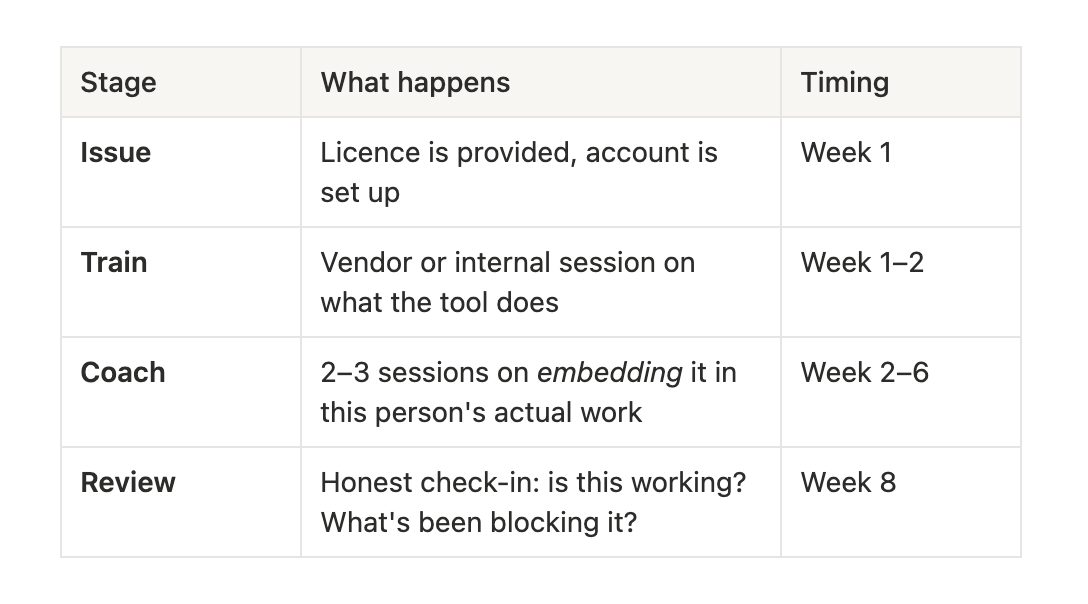
Most organisations do Issue and Train, then go quiet. Coach and Review are where the licence actually starts paying for itself.
Where Flourishing fits
We work alongside assistive-tech providers — including AtW-funded coaching that complements tools like those from CareScribe — to do exactly the Coach and Review stages. Every one of our coaches has lived experience of ADHD and is professionally qualified (ICF or ADDCA). We've seen what works and what stalls, and we tailor the embedding work to the individual rather than the tool.
If you've issued assistive tech to one or more employees and you're quietly unsure whether it's landing, that's a conversation worth having.
Book a free 30-minute call to talk through what you've issued and where it's stuck. No pitch — we'll either show you how to embed it, or tell you honestly that you don't need our help.